Starmer Resigns: Will the UK's Clean Energy Strategy Stay on Course? Implications for Offshore Wind Markets in Japan and Taiwan
2026/6/25
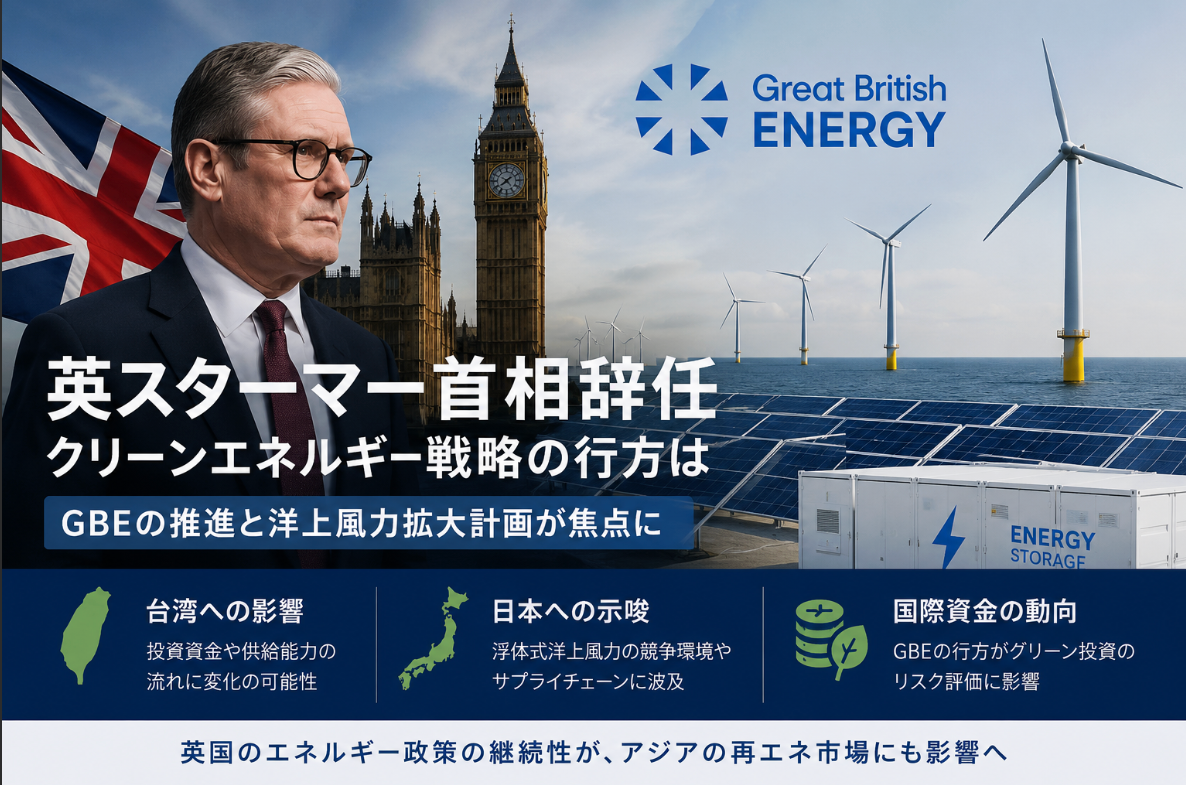
UK Prime Minister Keir Starmer announced his resignation on June 22, prompting renewed attention to the future of the country's energy transition and its implications for the global renewable energy industry. With former Greater Manchester Mayor Andy Burnham widely seen as the leading contender to succeed him, investors and industry stakeholders are closely watching whether the UK's clean energy agenda will remain intact under a new administration.
Since taking office in 2024, Starmer positioned the UK as a "Clean Energy Superpower," making decarbonization a central pillar of his government. A key initiative was the establishment of Great British Energy (GBE), a publicly owned investment company designed to accelerate renewable energy deployment and strengthen the country's energy independence.
According to GBE's five-year strategy, the UK aims to add approximately 15 GW of renewable energy and energy storage capacity by 2030, leveraging £8.3 billion in public funding to attract private-sector investment. Priority areas include offshore wind, community energy projects, and battery storage, all intended to reinforce both energy security and industrial competitiveness.
Policy continuity likely, but uncertainty remains
Despite the leadership change, analysts generally expect the UK's overall decarbonization strategy to remain largely intact.
Burnham has not publicly advocated abandoning either the UK's legally binding 2050 net-zero target or the GBE framework. Most observers believe a new government would be more likely to adjust fiscal priorities and industrial policy than fundamentally reverse the country's energy transition.
Nevertheless, political risks have become increasingly apparent.
Debate over net-zero policies has intensified in recent years amid concerns over energy prices, public spending, and economic competitiveness. Conservative and right-leaning political groups have called for expanded North Sea oil and gas production while criticizing the cost of renewable energy subsidies. Even during Starmer's tenure, parts of the government's green investment commitments were scaled back under mounting political pressure, highlighting the growing challenges of sustaining long-term climate policies.
Taiwan: Potential shifts in capital and supply chains
For Taiwan, the immediate impact is expected to be limited, but indirect effects could emerge through the offshore wind industry.
The UK and Taiwan are both among the world's leading offshore wind markets, with many international developers, equipment suppliers, and financial institutions active in both regions.
Should investment momentum slow in the UK, portions of global capital, manufacturing capacity, and engineering resources could shift toward Asia-Pacific markets, potentially benefiting Taiwan's next phase of offshore wind development.
Conversely, if the UK continues its planned expansion, global competition for turbines, subsea cables, installation vessels, and other critical offshore wind resources is likely to intensify.
London also remains one of the world's leading green finance hubs. Any weakening of GBE's investment momentum could influence international investors' risk assessments and capital allocation strategies, potentially affecting financing conditions for large-scale renewable energy projects in Taiwan.
Japan: A key reference for floating offshore wind
For Japan, the UK's political transition carries strategic significance beyond domestic British politics.
The UK has long been a global leader not only in fixed-bottom offshore wind but also in the commercialization of floating offshore wind, an area where Japan is actively building its own industrial base. British policy frameworks and supply-chain development have served as important references for Japan's national floating offshore wind strategy.
If policy uncertainty causes the UK to slow investment, Japan could gain opportunities to attract international capital, technology partnerships, and engineering expertise.
However, if GBE continues driving large-scale renewable investment, Europe and Asia may experience simultaneous expansion of offshore wind development, intensifying global competition for skilled labor, specialized vessels, manufacturing capacity, and critical components.
Demand from the UK market could significantly influence global supply chains, particularly for subsea cables, foundations, floating platforms, and installation vessels that are also essential to Japan's offshore wind ambitions.
------------------------------------------------------------------------------------------
Starmer's resignation is more than a political event in the UK—it is a test of whether long-term energy transition policies can withstand changes in government.
Decarbonization strategies require investment horizons measured in decades. If policy direction shifts with every election cycle, investor confidence inevitably weakens, making it more difficult to mobilize the long-term capital required for large-scale renewable energy infrastructure.
For years, the UK has been regarded as a global benchmark for offshore wind development and climate governance. The current political transition underscores a broader question facing many advanced economies: Can ambitious net-zero strategies remain durable across political cycles?
For both Japan and Taiwan, the lesson extends beyond renewable energy targets themselves. The greater challenge lies in creating stable policy frameworks capable of maintaining long-term investor confidence regardless of changes in political leadership.
The next phase will be defined by whether a new UK government continues to advance Great British Energy, delivers on its 2030 clean power commitment, and sustains the country's offshore wind expansion.
The outcome will not only shape the direction of global green investment but could also influence the competitive landscape for offshore wind industries across both Japan and Taiwan.
This content was published on WindTAIWAN and is shared in collaboration with ENERGYNIPPON.